
Every organisation loses value somewhere between strategic intent and operational delivery. The scale varies, the mechanisms differ, but the pattern is consistent. The strategy describes a clear path to value creation. The financial plan quantifies it. And somewhere in the operational reality of the business, a portion of that value fails to materialise.
This is value leakage, and it is one of the most common yet least well-diagnosed operating model problems.
The difficulty is that value leakage is rarely visible in any single metric or report. It does not announce itself as a line item in the P&L. It shows up instead as a pattern: targets that are consistently almost-met, cost savings that are delivered on paper but never reach the bottom line, revenue initiatives that are slower to land than planned, and a general sense within the leadership team that the organisation is working hard but not converting effort into result.
Where value leaks
Value leakage tends to occur in three places simultaneously, which is part of why it is difficult to address.
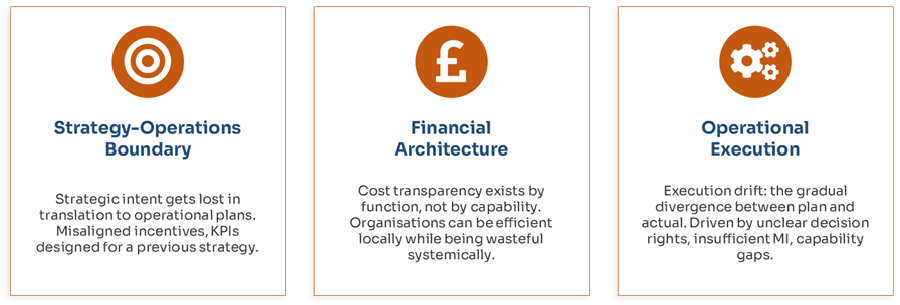
The first is at the strategy-operations boundary. This is where strategic intent gets translated into operational plans, and where ambiguity creates room for drift. If the strategy calls for a shift in customer proposition, but the operating model still incentivises the old behaviours, the strategy will be undermined by the operational reality. The misalignment is often subtle, embedded in KPIs, incentive structures, or resource allocation processes that were designed for a previous strategy.
The second is within the financial architecture. Cost transparency is a prerequisite for value management, and most organisations have less of it than they believe. Costs that are allocated by function or cost centre, rather than by capability or value stream, make it very difficult to understand where money is being spent relative to where value is being created. Organisations can be efficient at a functional level while being wasteful at a system level, simply because nobody has visibility of the full picture.
The third is in operational execution. Even when strategy is clear and financial architecture is sound, value can leak through execution drift: the gradual divergence between planned and actual performance that accumulates over months and quarters. This is often driven by unclear decision rights, insufficient management information, or a gap between the capabilities the organisation needs and the capabilities it actually has.
The mechanisms of leakage
Several specific mechanisms are worth identifying, because they recur across sectors and business types.
Misaligned incentives are among the most common. When individuals or teams are measured and rewarded against metrics that do not align with the strategic intent, their behaviour will optimise for the metric rather than the strategy. This is not malicious. It is rational, and it is a design failure.
Poor cost transparency is a close second. Organisations that cannot see their cost base by capability or value stream cannot make informed trade-off decisions. They default to across-the-board cuts or functional efficiency targets that may reduce cost in one area while creating cost or risk elsewhere.
Capability gaps create leakage when the organisation lacks the ability to execute at the level the strategy requires. This shows up as delays, rework, and dependency on external support that was not anticipated in the business case.
Execution drift, the gradual divergence from plan, is the most insidious because it is incremental. Each monthly variance is small enough to explain away. The cumulative effect, visible only at year-end or during a periodic review, is often significant.
Addressing value leakage
The first step is diagnosis: understanding where leakage is occurring and through which mechanisms. This requires looking across the three boundaries simultaneously, not treating strategy, finance, and operations as separate domains with separate problems.
The second step is design: ensuring that the operating model is configured to minimise leakage. This means aligning incentives to the strategic intent, building cost transparency at the capability level, closing the most critical capability gaps, and creating management information that makes execution drift visible early.
The third step is discipline: maintaining the alignment over time. Value leakage is not a one-off problem. It recurs whenever the strategy evolves, the market shifts, or the organisation changes. Periodic review, using a framework like the Value Operating System, helps organisations identify and address leakage before it compounds.
For PE-backed businesses, where value creation is the central objective and the hold period is finite, value leakage represents a direct threat to returns. Identifying and addressing it early in the ownership cycle, rather than discovering it during exit preparation, can make a material difference to outcome.