
Bridging strategy and execution so operating designs deliver value
We work with leadership teams in businesses of all sizes and PE-backed portfolio companies to fix the structural operating choices that determine whether strategy creates value or stalls on delivery.
Design that starts from capabilities, not org charts
Decision rights, governance, and service ownership aligned to value
Focused on the small number of choices that drive disproportionate impact
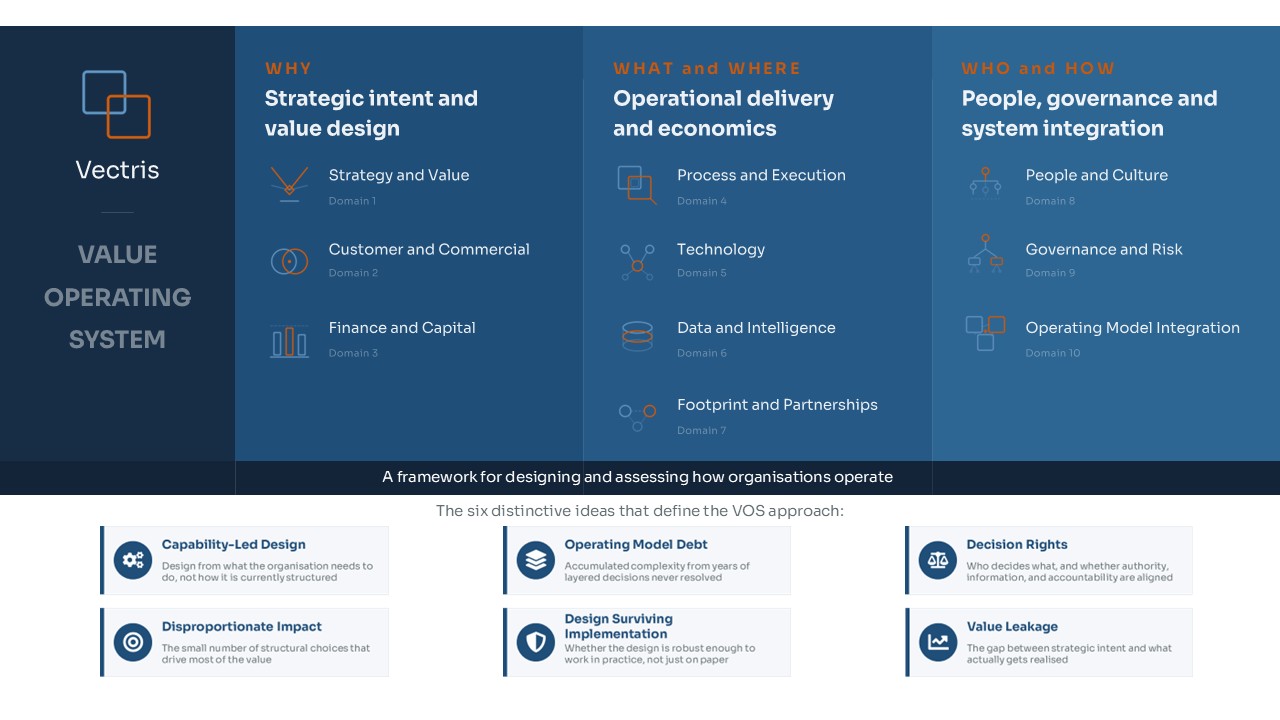
The Value Operating System
Most operating model work starts in the wrong place: restructuring teams, mapping processes, or selecting technology. These are outcomes of good design, not starting points.
The Value Operating System (VOS) is a diagnostic and design framework built around ten operating domains and six core concepts. It starts from what the organisation needs to be able to do — the capabilities — and designs outward from there, connecting strategic intent to operational reality.
VOS helps leadership teams see where operating model debt has accumulated, where value is leaking between what was designed and what actually operates, and which structural choices will unlock the most value in the shortest time.
Our Expertise
Operating model strategy
Designing target operating models that connect strategy to execution. Whether you are planning a transformation, navigating post-deal integration, or addressing structural performance gaps, helping you design operating models your organisation can actually implement and sustain.
VOS assessment and design
Assessing your current operating model using VOS principles to identify operating model debt, value leakage, and misaligned decision rights. Creating clear, prioritised roadmaps based on business impact rather than comprehensive redesign of everything.
Implementation and advisory support
Bridging the gap between design and reality. Whether you need interim leadership, implementation oversight, or advisory support for internal teams, ensure operating model improvements survive contact with your organisation — not just the steering committee.
Where we focus
Corporate transformation
Enterprise operating model design, post-restructuring integration, and capability-led redesign for organisations that need their operating model to catch up with their strategy.
PE value creation
Operating model assessment for due diligence, portfolio company optimisation, and post-deal integration. Identifying where operating model debt and value leakage are eroding returns.
Complex and regulated environments
Designing operating models that work within regulatory constraints, multi-entity structures, and environments where governance, risk, and compliance shape every design choice.
What Our Clients Say

“Vectris worked very closely with our client-facing and internal departments to understand, review and document our process flows, documentation and templates. Within a very short period of time they created an operational framework that is extremely valuable for us as we move into the implementation of suggested improvements and our overall approach to managing change going forward“
Fintech senior leader, in high growth phase
“Methodical, thorough and presented complex information in a very clear way. This enabled the exec committee to make difficult decisions more effectively and with mitigated risk based on the information provided. Calm in approach but very clear on message. Challenges appropriately with the data and evidence ready to back up his points“
Operations Director, global automotive brand
Latest thinking
Practical frameworks and perspectives on operating model design, drawn from real engagements across corporate transformation and PE value creation.
Operating model debt: the hidden cost of not deciding
Every organisation accumulates complexity. Processes that were introduced for a specific reason and never retired. Roles that were created during a reorganisation three cycles ago and still exist. Technology that was meant to be temporary and became permanent....
M&A, carve-outs, and divestments: applying the Value Operating System in deal contexts
Operating model design under deal timelines is a different discipline from operating model design in steady state. The constraints are harder: time is compressed, information is incomplete, the organisation is distracted by the transaction itself, and the stakes are...
Value leakage: where strategy meets operations and money disappears
Every organisation loses value somewhere between strategic intent and operational delivery. The scale varies, the mechanisms differ, but the pattern is consistent. The strategy describes a clear path to value creation. The financial plan quantifies it. And somewhere...