
Every organisation accumulates complexity. Processes that were introduced for a specific reason and never retired. Roles that were created during a reorganisation three cycles ago and still exist. Technology that was meant to be temporary and became permanent. Governance mechanisms that duplicate rather than replace what came before.
This accumulated complexity has a cost. Not a visible, line-item cost, but a drag on execution speed, decision quality, and the organisation’s ability to adapt. I call this operating model debt, and it behaves very much like financial debt: it accumulates gradually, it compounds over time, and it is easiest to address when it is smallest.
How debt accumulates
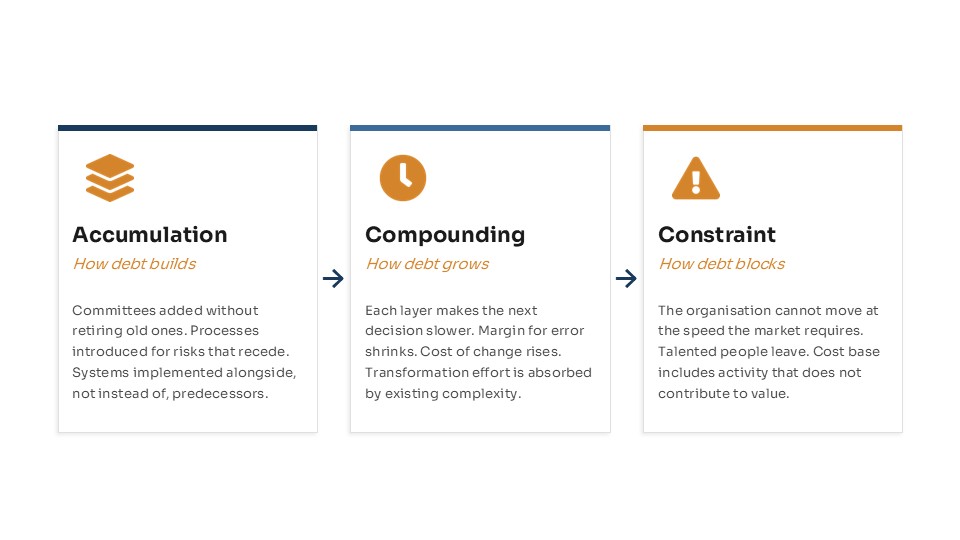
Operating model debt accumulates through decisions that are individually reasonable but collectively burdensome. A new committee is created to address a governance gap, but the old committee is not disbanded. A process is introduced to manage a specific risk, but the risk recedes and the process remains. A technology system is implemented alongside, rather than instead of, the system it was meant to replace. A matrix structure is adopted, adding a reporting line without removing one.
Each of these decisions makes sense in its moment. The problem is that nobody tracks the cumulative effect. There is no operating model balance sheet that shows the total debt load. Instead, the debt manifests as friction: things that should be straightforward take longer than they should. Decisions that should be clear require multiple approvals. Information that should be available is scattered across systems that do not communicate.
Why organisations tolerate it
Operating model debt persists because it is easier to add complexity than to remove it. Adding a process, a committee, or a system is a bounded, manageable action with a clear purpose. Removing one requires understanding its dependencies, managing the political implications, and accepting a short-term disruption for a long-term benefit. In most organisations, the incentive structure favours action over removal.
There is also a visibility problem. Financial debt is measured and reported. Operating model debt is not. There is no standard metric, no reporting framework, and no regular review cycle. The debt accumulates silently until a trigger event makes it visible: a failed transformation, a deal that requires operational clarity, or a new leader who asks questions that the organisation cannot easily answer.
The third factor is risk aversion. Removing a process or disbanding a committee carries the risk that the thing it was managing will resurface. This risk is real but often overstated, and it creates a one-directional ratchet: complexity is added but rarely removed.
The compounding effect
Like financial debt, operating model debt compounds. Each layer of complexity makes the next layer harder to navigate and the next decision slower to make. An organisation with moderate debt can still operate effectively, but the margin for error is smaller and the cost of change is higher.
At a certain point, the debt load becomes material. The organisation cannot move at the speed the market or its investors require. Transformation programmes fail because the existing complexity absorbs the change effort. Talented people leave because the environment is frustrating. And the cost base includes a significant proportion of activity that does not contribute to value creation.
This is not a hypothetical. Most large organisations carry more operating model debt than they recognise. The evidence is in execution speed, in cost-to-income ratios that resist improvement, and in the recurring experience of transformation programmes that deliver less than expected.
Addressing operating model debt
Reducing operating model debt is not a single initiative. It is a discipline. It begins with visibility: cataloguing the decision rights, governance mechanisms, processes, and technology that the organisation maintains, and assessing which are still serving their original purpose.
The assessment does not need to be exhaustive. The 80/20 principle applies: a relatively small number of accumulated decisions will account for a disproportionate share of the friction. Identifying those, through structured review using a framework like the VOS, and addressing them deliberately is more effective than attempting a comprehensive clean-up.
The longer-term discipline is to build operating model review into the regular management cycle, with the same rigour as financial review. This means periodic assessment of whether governance mechanisms, processes, and structures are still fit for purpose, and a willingness to retire those that are not.
Operating model debt is not a failure. It is a natural consequence of how organisations evolve. The failure is in not recognising it, not measuring it, and not addressing it before it constrains what the organisation can do.