
Most organisations can describe their governance structure with reasonable confidence. There are boards, committees, terms of reference, and escalation paths. The architecture exists. What is often absent is clarity about how decisions actually get made, and by whom.
Decision rights sit at the intersection of governance, process, and people. They determine who has authority to commit resources, approve changes, set direction, and resolve disputes. When they are clear and well-aligned, organisations move with purpose. When they are unclear, and they usually are, the result is a familiar pattern: decisions deferred upward, parallel conversations that never converge, and a pervasive sense that progress requires either heroic individual effort or an executive intervention.
This is not a governance problem. It is an operating model problem, and one that most operating model work fails to address directly.
The gap between structure and practice
Governance structures describe how an organisation is meant to operate. Decision rights describe how it actually does. The distinction is important because the two are often misaligned, not through failure but through accumulation. Over time, organisations add committees without retiring old ones, create new roles without clarifying their authority relative to existing ones, and introduce approval processes that duplicate rather than replace what was there before.
The result is what might be called decision rights debt: a layered, often contradictory set of authorities that has evolved without deliberate design. Individuals learn to navigate it through experience and relationships rather than through clarity of role. This works until it does not, typically when the organisation faces a significant change, a new leadership team, or a transaction that demands speed and precision.
Three dimensions of decision rights
Decision rights span three dimensions, and most organisations address only one.
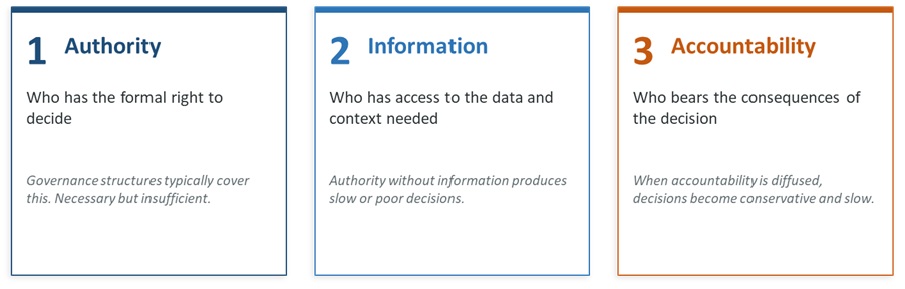
The first is authority: who has the formal right to decide. This is the dimension that governance structures typically cover. It is necessary but insufficient. Knowing who sits on which committee does not mean knowing who actually approves a pricing change or a headcount request.
The second is information: who has access to the data and context needed to make a good decision. Authority without information produces slow or poor decisions. In many organisations, the people with decision authority are several levels removed from the operational reality that should inform those decisions. The information either reaches them late, filtered, or not at all.
The third is accountability: who bears the consequences. When accountability is diffused, shared across committees, spread across functions, or simply unassigned, decisions tend to be conservative, incremental, and slow. Nobody wants to own a decision that might go wrong when there is no clarity about what happens if it does.
Effective decision rights align all three. The person or body with authority also has access to the right information and bears genuine accountability for the outcome. This sounds obvious, but in practice it requires deliberate design. It does not happen by default, and it is rarely addressed in conventional operating model work.
Where decision rights break in practice
There are predictable patterns. In large corporates, decision rights tend to migrate upward over time. As organisations add controls and approval layers, often in response to a specific incident or regulatory requirement, decision-making authority concentrates at senior levels that lack the bandwidth to exercise it effectively. The result is a bottleneck that masquerades as diligence.
In PE-backed businesses, the pattern is different. Decision rights are often unclear because the boundary between investor and management is ambiguous. Operating partners, board observers, and portfolio management teams all have influence, but the formal decision architecture may not reflect how that influence is actually exercised. Speed demands clarity, and ambiguity costs time.
In post-merger organisations, the problem is duplication. Two predecessor companies, each with their own decision rights, are merged without a deliberate redesign. The result is parallel authorities, competing escalation paths, and an organisation that cannot move decisively because it has not resolved which set of rules apply.
What good looks like
Designing decision rights well is not complicated, but it does require discipline. It starts with identifying the twenty to thirty most important decisions the organisation makes on a recurring basis, not every decision, just the ones that drive disproportionate impact. For each, three questions should be answerable: who decides, what information do they need, and who is accountable for the outcome.
Where the answers are unclear or contradictory, the design work begins. This is not a governance review in the traditional sense. It is a practical exercise in mapping how decisions flow through the organisation and ensuring that the flow is deliberate rather than inherited.
The implications are broader than they first appear. Clear decision rights reduce the need for escalation, which reduces the burden on senior leadership. They enable faster execution, which matters in time-pressured contexts like post-deal integration. And they create the conditions for genuine accountability, which is the foundation of any well-functioning operating model.
For organisations serious about operating model effectiveness, decision rights should be designed with the same rigour as organisational structure or technology architecture. They are not a soft, cultural issue. They are a structural one, and one of the highest-leverage interventions available.